


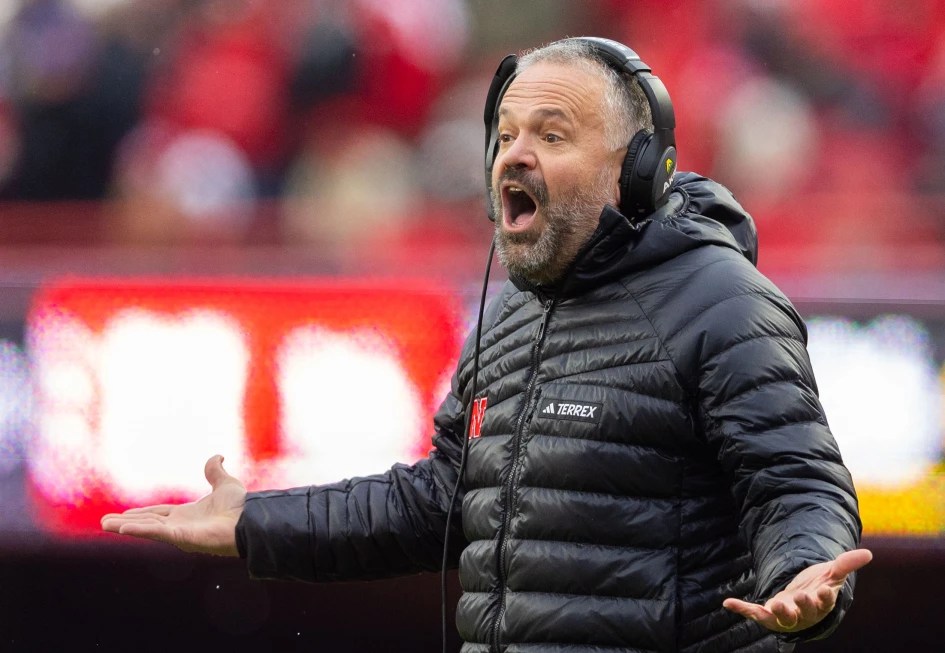
Nebraska head coach Matt Rhule disputes a referee’s call after Nebraska made a safety against Iowa during the second half of an NCAA college football game Friday, Nov. 28, 2025, in Lincoln, Neb. (AP Photo/Rebecca S. Gratz, File)
STEVE MEGARGEE | Associated Press
The disappearance of the spring transfer portal window creates the opportunity for a reappearance of spring football games in campuses across the country.
Playing a game in front of fans to end spring practice had become a fading tradition in the age of conference networks and the transfer portal. Coaches feared the possibility that rival staffs could watch televised spring games and turn them into scouting opportunities.
“It just didn’t incentivize us to be out there playing when people could watch that tape on national TV and call a kid,” said Nebraska coach Matt Rhule, who did away with the spring game last year.
That’s not as much of a concern now that college football no longer has a second transfer portal window in April. Nebraska responded to the change by bringing back its spring game.
“We missed it,” Rhule said. “We wanted to do it. … It’s a great thing for the fans. It’s a great thing for people who want to come watch us play. Once they kind of changed the calendar, we went back to a more traditional setting.”
Nebraska is holding spring practice earlier than most schools, as it held its first workout Feb. 21 and will conduct its spring game March 28. Most schools won’t finish spring practice until April.
At least a handful of Football Bowl Subdivision programs that responded to a survey from The Associated Press have decided to hold traditional spring games this year after not having them in 2025. That list also includes Auburn, UConn, North Texas and San Diego State, among others.
Auburn, UConn and North Texas made their decisions following coaching changes. New staffs decided to go with new approaches that included going back to college football’s past.
Spring football games once were an offseason staple. Teams would close spring practices by playing a game in front of thousands of their fans, either by matching the offense against the defense or conducting a pregame draft that divided the team into two separate rosters.
But less than half the Bowl Subdivision schools that responded to the AP’s survey indicated they had a traditional spring game last year.
The change happened in part because of the arrival of a mid-April transfer portal window that opened as most teams were closing spring practice. Teams nowadays still hold some sort of event to mark the end of spring practice, but it usually doesn’t have a typical game format.
For instance, Nebraska had a skills competition last year that included a 7-on-7 game. Other schools staged open practices with some scrimmaging.
San Diego State also had a skills event similar to the Pro Bowl Games format that the NFL has adopted. This year, San Diego State instead plans to have an Offense vs. Defense spring game on May 2.
“We will block and we will tackle,” San Diego State coach Sean Lewis said. “It’s not going to be fan fest. It’s not going to be dodgeball, right? Hearing some feedback from the fans year to year, obviously things are a little bit different, but with no spring portal, we can do things a little bit differently.”
The NCAA removed the second window last fall and made Jan. 2-11 the lone opportunity for players to enter the portal. Coaching staffs don’t have to worry anymore about players transferring after spring practice.
But this shift in the college football calendar also could cause teams to be cautious about how they handle spring workouts.
For instance, Wisconsin lost projected starting left tackle Kevin Heywood to a torn anterior cruciate ligament at spring practice last year. The Badgers responded by signing offensive lineman Davis Heinzen, who had entered the portal after starting 36 consecutive games at Central Michigan.
Teams won’t have nearly as many options this year to find replacements if a key player suffers a season-ending injury in practice.
“For the most part, there’s not going to be a whole lot of people available after spring football,” Wisconsin coach Luke Fickell said. “We all know what can happen in spring ball. There’s still a bunch of people who won’t have homes, so I still think if people around the country need something in April, there will be some opportunities with guys out there, but I don’t think that’s something you can bank on.”
Fickell acknowledged the balancing act coaches face as they try to get their teams as prepared as possible while avoiding injuries.
“We’re trying to find what that balance looks like and how do we practice physical, how do we do the demanding things that you have to do to get better at the game of football while also being smart and making sure our highest-end guys, we’re in a position to make sure they’re getting better but that we’re going to get them through the summer and get them into the start of the fall,” Fickell said.


 jbiaprepillustrated.blog