

Tyler Tachman | Des Moines Register
IOWA CITY — After a thrilling run to the Elite Eight, Iowa basketball is working to fill out its roster for the 2026-27 season.
As of April 14, the Hawkeyes have only lost one player to the transfer portal — Alvaro Folgueiras. After an up-and-down regular season, Folgueiras emerged as a March Madness star, hitting the game-winning 3-pointer in Iowa’s second-round upset of 1-seed Florida.
Iowa is guaranteed to lose at least two other players — Bennett Stirtz and Brendan Hausen — who have exhausted their college eligibility. Stirtz, who is projected to be a first-round pick in the 2026 NBA Draft, is a significant departure.More: What Iowa basketball is getting in ‘explosive’ wing Jaidyn Coon.
Tavion Banks’ future is still unclear. He just wrapped up his fourth season of college basketball, but because he spent two seasons at the junior college level, he could be granted additional eligibility.
Here are some transfer portal names to keep an eye on as Iowa looks to add to next season’s roster.
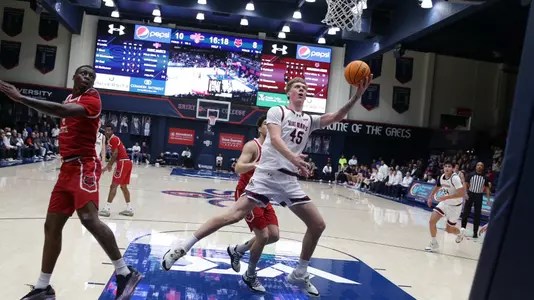
Andrew McKeever, Saint Mary’s
McKeever, listed at 7-foot-3 and 285 pounds, averaged 8.2 points, 9.2 rebounds and 1.8 assists in roughly 23 minutes per game as a redshirt sophomore last season.
The Hawkeyes played with an undersized frontcourt last season and it was clear they needed to add size ahead of coach Ben McCollum’s second campaign. McKeever, a prolific rebounder, could give them a much-needed boost on the interior.
He had 12 games last season in which he grabbed at least 10 rebounds. McKeever’s rebounds per 40 minutes last season were an impressive 15.7. His rebounding can also help on the offensive end with second-chance opportunities. He averaged 3.8 offensive rebounds per game last season.
Simply put, McKeever is the type of mountainous presence that Iowa didn’t have last season and would make the Hawkeyes more equipped to thrive in the Big Ten.
Ace Glass III, Washington State
The 6-foot-3 guard averaged 16.4 points, three rebounds and 2.3 assists per game as a true freshman. Glass was selected to the All-West Coast Conference second team and All-WCC Freshman Team.
He set Washington State’s freshman scoring record and freshman 3-point record, the latter of which was previously held by Klay Thompson. Glass scored in double-figures in 27 of his 32 appearances last season, including a career-high 40 points against Arizona State. He was 9-of-14 from the field, 6-of-9 from deep and 16-of-18 from the free throw line in that explosive performance against the Sun Devils.
Iowa’s ability to replace Stirtz is one of the big storylines entering McCollum’s second season at the helm. It would be unfair to expect a replica of Stirtz, but as long as Iowa can get very good point guard play and surround him with an improved supporting cast, the Hawkeyes should be in good shape.
On paper, Glass checks a lot of boxes, particularly with his scoring and playmaking.
Drew Scharnowski, Belmont
The 6-foot-9 forward was a member of both the Missouri Valley Conference first team and All-Defensive team last season. He averaged 10.7 points, six rebounds, 2.6 assists and 1.3 blocks in roughly 22 minutes per game.
The redshirt sophomore dropped a near triple-double against Murray State in January, logging 19 points, 11 rebounds and nine assists. He also had two games last season in which he blocked five shots — against Indiana State and College of Charleston. Rim protection and rebounding are areas Iowa needs to improve. Scharnowski’s per 40-minute averages last season in blocks (2.4), rebounds (11.1) and offensive rebounds (3.9) indicate he could use his athleticism to help Iowa in those areas.
Scharnowski is an efficient scorer inside the 3-point arc. He shot nearly 67% from the field across two seasons, which came almost exclusively from 2-point range.
Ty’Reek Coleman, Illinois State
The 6-foot-2 guard averaged 10 points, 2.7 rebounds and 1.8 assists per game as a true freshman.
Coleman’s efficiency was impressive, considering it’s not abnormal for younger guards to struggle with that. He finished the season shooting 50.4% from the field and 41.6% from deep.
Illinois State advanced to the NIT semifinal, where it faced Auburn. Notably, Coleman had 17 points on 7-of-12 from the field and 3-of-5 from deep against the Tigers, showing his ability to perform against power conference competition. Granted, he was also held scoreless against Wake Forest two games earlier.
There would be slightly more risk in taking a player like Coleman, because he would be making a sizeable leap in competition after just one season in the Missouri Valley Conference. But it’s not difficult to see his potential, and he still has three seasons left to continue developing.

 jbiaprepillustrated.blog