


Bob Nightengale | USA TODAY
Why MLB owner thinks adding more teams is ‘stupid’
MLB owners and executives expressed strong doubts about any near‑term expansion, citing financial concerns and the lack of discussion in current collective‑bargaining talks, even as Commissioner Rob Manfred has said he would like to add two teams before he leaves office.
Key points:
Anonymous MLB owners and executives said expansion would be “stupid” and is not being discussed right now.
Expansion has not been addressed in the early collective bargaining agreement negotiations between MLB and the players union.
Commissioner Rob Manfred has said he wants to add two more teams before his term ends in January 2029.
Potential expansion fees for new clubs are estimated at around $3 billion each.
When MLB expanded in the 1990s, the Marlins and Rockies each paid $95 million, while the Diamondbacks and Rays each paid $130 million in expansion fees.
They had a lavish press conference in Sacramento this week featuring balloons, baseball caps, politicians and even future Hall of Fame manager Dusty Baker, letting Major League Baseball know they have the money, the land and the passion to be part of their exclusive club.
They have a star-studded staff of advisors in Nashville, an office constantly pumping out press releases, and even though they have no actual ownership, already chosen a team name.
They have already started seeking investors in Vancouver. They have everything set but the shovels in the ground in Salt Lake City.
Everywhere you turn, whether it’s in Charlotte, Portland, Orlando or Montreal, there’s a clamoring to be prepared the moment MLB announces it is ready to expand.
Well, what if everyone is wasting their time?
What if, after all of these years of hype and promises, MLB is not ready to expand in 2031, 2032 or 2033?
What if expansion simply doesn’t happen?
USA TODAY Sports asked a handful of MLB owners and owners and executives for their take on the potential of expansion, speaking on the condition of anonymity due to the ongoing nature of the situation.
“I don’t think it’s going to happen, I really don’t,” one longtime MLB executive said.
Said one owner: “Expansion would just be stupid.”
Said another owner: “It’s not anything that’s being discussed right now, I know that.”
Indeed, expansion has not been addressed in the early collective bargaining agreement talks between MLB and the players union. It’s expected to be tabled until after a CBA agreement is reached.
So, once there’s a new CBA, whenever that is, just why wouldn’t there be expansion?
The players union would love it, with 52 new jobs coming to MLB. The owners would love it, with expansion fees for each team expected to be perhaps $3 billion.
Commissioner Rob Manfred would love it, wanting expansion as part of his legacy, and already on record wanting to add two more teams before he leaves office in January 2029.
“When people want your product,” Manfred said last week on the Pat McAfee Show, “I think it’s kind of incumbent on you to try to figure out a way if you can deliver that product to them.”
The schedule makers would love it, knowing it’s much easier to comprise a 162-game schedule featuring 32 teams than 30. And the players would love it, with expansion bringing massive realignment, reducing travel and the frequent cross-country flights.
Yet, as several owners and executives say, the biggest problem with expansion is that it doesn’t make sense financially.
“Why would we want to subsidize two more small-market teams?” one executive said. “I don’t understand it. The economics don’t add up.”
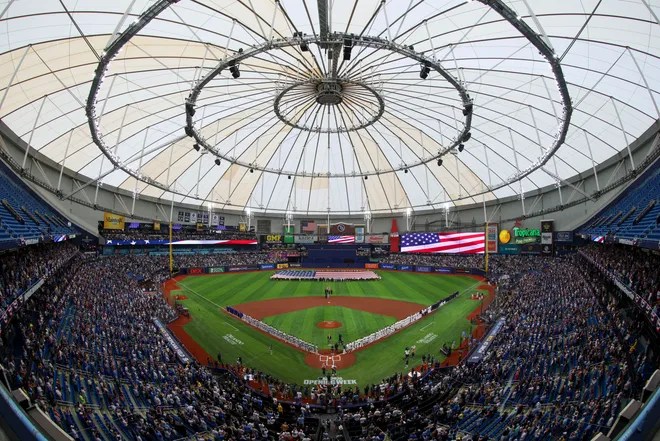
There’s no need to look further for evidence than the two Florida teams when MLB expanded in 1993 with the Miami Marlins and Colorado Rockies, and again in 1998 with the Tampa Bay Rays and Arizona Diamondbacks.
The Marlins, who won two World Series titles in their first 10 years, have finished last or next-to-last in National League attendance in all but one year since 1998. The only time they’ve drawn more than 2 million fans since 1997 was when they moved into their new ballpark in 2012.
The Rays, who have won two American League pennants and have been to the postseason nine times since 2008, have finished last or next-to-last in AL attendance 21 years, drawing more than 2 million fans only in their 1998 inaugural season.
So, guess who’s been subsidizing these teams, with MLB executives estimating that the Marlins alone have received about $4.5 billion in revenue sharing from the central fund since their birth into MLB.
How does that investment look to their fellow owners with the Marlins and Rockies paying just $95 million in expansion fees, the Diamondbacks and Rays paying $130 million, with none of the teams among the revenue sharing payees?
So now, with Manfred wanting every team to share their local TV revenue, and new national TV contracts coming in 2029 that MLB estimates could be worth $250 million per team, do owners really want to cut out two more slices of that pie and hand the money over to the new teams?
The two expansion cities will likely be low-revenue teams with small TV markets, but they would be sharing the same national TV revenue pie as the Dodgers, Yankees and the other big boys.
“Those teams certainly won’t be paying money into revenue sharing,” one owner said, “so it will be less money for everyone else. What’s the added benefit, to get more fans engaged? I’m not sure expansion will drive fan engagement in either market. So, we’ll see what happens once our labor deal is done.
“But I really don’t understand the logic for expansion, at least not yet.”

 jbiaprepillustrated.blog