

A source cautioned that Friday’s announcement didn’t eliminate Arlington Heights from consideration, were the state to find a way to give the Bears property tax certainty on the 326-acre plot they own.
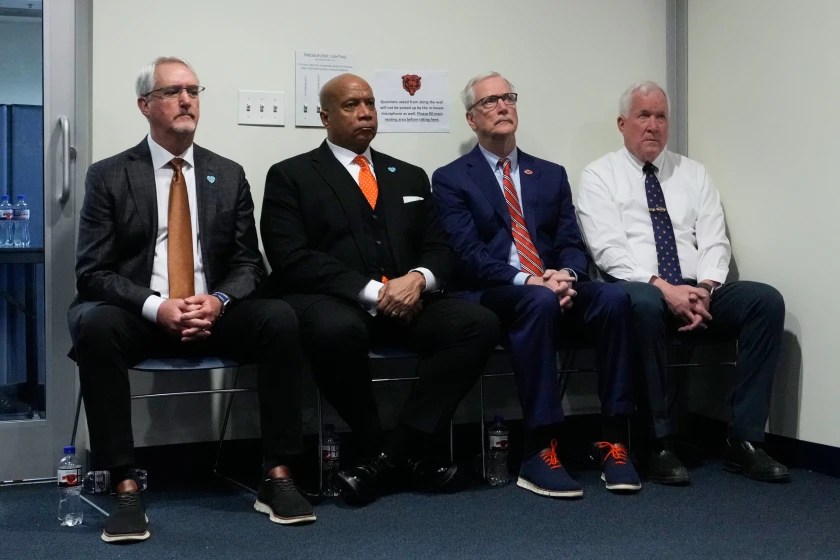
Chicago Bears owners Brian McCaskey, left, George McCaskey, second from right, Patrick McCaskey, right, and Chicago Bears President and CEO Kevin Warren listen to general manager Ryan Poles at a news conference in Lake Forest, Ill. (AP Photo/Nam Y. Huh, File)
Patrick Finley and Fran Spielman | Chicago Sun-Times
The Bears’ board of directors met Thursday and decided to move forward with their plans to build a stadium in Indiana, positioning the team to play its home games out of state for the first time in its 106-year history.
The Bears’ Friday announcement to “advance our stadium development project in Hammond” tips the scales significantly toward Indiana — but falls well short of eliminating Illinois from contention.
The precise stadium site in Hammond depends on which permutations of the Wolf Lake property the Bears choose. The Bears have a long list of boxes to check, too, ranging from environmental reports to traffic surveys to financial agreements.
A league source cautioned the announcement didn’t eliminate Arlington Heights as an option, were the state to find a way to give the Bears property tax certainty on the 326-acre plot they own. In fact, the source said, there was “still a lot of ballgame left to play” for Illinois lawmakers. It’s unclear whether waiting until the Senate and House reconvene this fall would be too late for the Bears, though. The team considers Arlington Heights — not Chicago — the only viable choice in Cook County.
The Bears were lured by a sweetheart deal approved by Indiana three months ago, when lawmakers authorized a stadium authority backed by taxes on admissions, hotels, restaurants and tolls. The Bears have committed $2 billion to their stadium project. The team would keep all revenue generated by the stadium and have the option to buy it back in 40 years, when Indiana taxpayers have paid off the bonds.
“We believe a world-class stadium project in Hammond will transform the region, connecting northwest Indiana and the South Side of Chicago through the Loop and across the neighborhoods and suburbs stretching north of the city,” Bears chairman George McCaskey and president/CEO Kevin Warren said a joint written statement.
Timelines remain fluid, but if the Bears decide to build in Hammond, they could start construction as soon as next spring and have a stadium built by 2031.
What made the announcement unique was Thursday’s board of directors vote, which hadn’t happened at any other point when the Bears vacillated between downtown, Arlington Heights and Hammond the past three years. Indiana’s proposal gave the Bears a concrete financial plan to consider, something that has yet to take shape in Illinois.
Still, Illinois lawmakers pointed to a lack of finality Friday. State Sen. Bill Cunningham said Warren told him Friday he looked forward to continuing to work together. Rep. Kam Buckner said in a written statement that neither the Bears’ declaration nor his own conversation with Warren “suggested Illinois is off the table.”
Gov. JB Pritzker’s office said in a statement that the Bears have “spent the last six years, and especially the last few months, shifting their position on a stadium location” and that Friday “appears to be another instance of that.” Gubernatorial candidate Darren Bailey’s office, meanwhile, blamed Pritzker for forcing “the heart and soul of Chicagoland to abandon its identity, its fans, and its state for more competitive waters.”
Referencing the greatest team in franchise history, Indiana Gov. Mike Braun said in a written statement that his state and the team “look forward to building a partnership as strong as the ’85 Bears defense.”
NFL spokesperson Brian McCarthy merely said the Bears have kept the league’s stadium committee and league office up to date on all developments. The Bears limited Warren and McCaskey’s comments to the team-issued statements.
Senior mayoral adviser Jason Lee, who was in Springfield during the closing hours of the spring session, said the Bears hadn’t made a final decision.
“They are focused on Hammond,” he said. “They’re going to advance a development in Hammond. They don’t have a site yet. And Bears officials noted that it’s not a done deal. That sounds exactly like we’ve been in a few other scenarios. Maybe a little bit behind a few announcements they’ve made in the past.
“They know and we know that all of this stuff is complicated and difficult. …There’s a lot of shoes that have to drop.”
Lee said the Bears “have made major efforts in multiple directions” over the years, so far with nothing to show for it.
“In Chicago, we had a site,” he said. “We had a lot of things they don’t even have in Hammond. That was two years ago. We’ve seen this movie before in terms of pivoting and then still be engaged. We’ll stay tuned. … The press can do what it will with this. There’s no rational basis for hysteria, but I’m sure that’s what we will get.”
Even if the Bears forge ahead with stadium planning in Hammond, Lee said he believes the team “still has an interest in an Illinois solution” that includes Johnson’s 2024 plan to build a lakefront dome that requires at least $900 million in hotel tax revenue and $1.5 billion in state infrastructure funding.
The stadium authority bill that cleared the Senate mirrored Johnson’s stalled stadium plan, he said.
“If Illinois is an option and the only structure is the Chicago structure, then Chicago remains an option for Illinois,” he said. “I don’t know what the other possibility would be in Illinois. If Illinois is not an option, then the statement should have said, ‘It’s over. We’re in Hammond.’ But it didn’t.”
If the Bears leave, Lee said the Museum Campus will survive and thrive as the “No. 1 tourist destination” in Illinois.
Indiana moved quickly to woo the Bears. Frustrated by the team’s inability to lower property taxes on the 326-acre former Arlington International Racecourse site, Warren said in December the team would expand its search to Northwest Indiana.
Inside their home state, the Bears pushed for PILOT legislation, which would have allowed them to negotiate payments in lieu of taxes with Arlington Heights and save them hundreds of millions of dollars over 40 years. That legislation died Saturday night, forcing Illinois lawmakers to try to fashion a last-minute option: allowing any Cook County municipality with at least 70,000 residents to create their own stadium financing authority, allowing the Bears to avoid paying property taxes. The bill passed the Senate at 3:39 a.m., but the House adjourned without voting on it about 45 minutes later.
Hammond Mayor Tom McDermott said earlier this week he expected the Bears to move quickly if they wanted to move to Indiana. The board of directors — chairman George McCaskey, president/CEO Kevin Warren, secretary Pat McCaskey and members Brian J. McCaskey, Edward L. McCaskey, Ed McCaskey Jr. and Pat Ryan — decided to do exactly that, though they stopped short of a final decision.
The Bears’ stadium search has lasted an exhausting five years. On June 17, 2021, the Bears submitted a bid to buy the Arlington site from Churchill Downs Inc. The Bears were in escrow in January 2023 when the team selected Big Ten commissioner Kevin Warren to replace Phillips, who was retiring. The Bears paid $197.2 million for the property a month later.
Frustrated by property tax prices in Arlington Heights, Warren turned his attention toward the lakefront and then back to the suburb. And now, seemingly, across state lines.

 jbiaprepillustrated.blog