

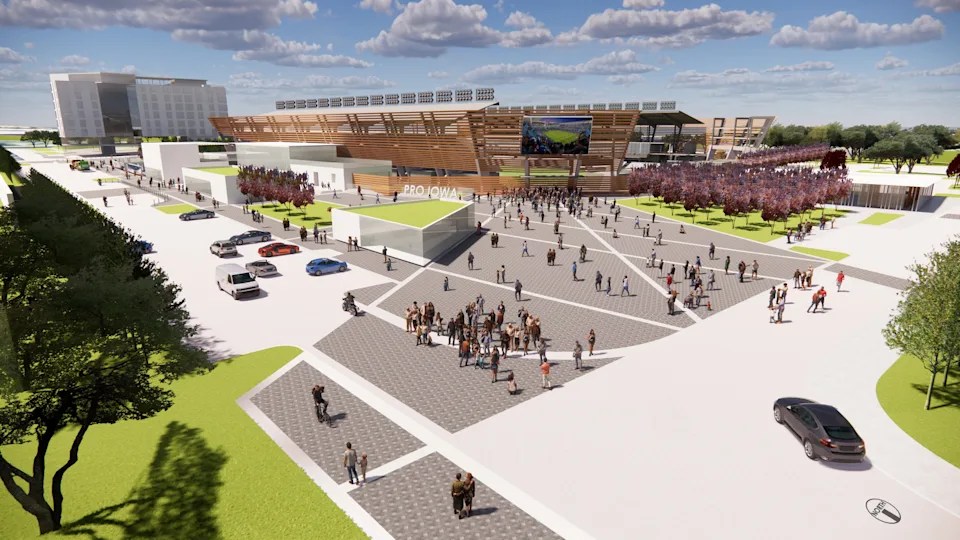
Pro Iowa and Krause+ plan an 8,000-seat soccer stadium and adjoining pedestrian plaza on a former Superfund site just southwest of downtown Des Moines.
Virginia Barreda | Des Moines Register
After years of delay, the developers behind Iowa’s first purpose-built pro soccer stadium have reached a lease agreement with the city of Des Moines, marking what could literally be a concrete step toward its construction on a rehabilitated Superfund site adjacent to downtown.
The Des Moines City Council gave unanimous approval at its Monday, June 8, meeting for the Iowa Soccer Development Foundation to receive a 50-year lease for the stadium site east and north of the Raccoon River and just south of Martin Luther King Jr. Parkway at SW 16th Street.
Known as the Dico site for the factory that once occupied it, the city-owned tract will house a soccer stadium with at least 5,500 seats where pro men’s and women’s teams could hit the field starting late 2028 or 2029. To be built just north of the stadium, the Global Plaza will serve as a pre- and post-game space and spot for other events and festivals, according to a City Council memo.
The Iowa Soccer Development Foundation will pay the city $656,075 annually to lease the site, according to the memo. Soccer foundation leaders opted to lease the land instead of owning it due to the property’s environmental concerns.
The group hopes to break ground for the stadium and plaza in late 2026 or in 2027, Jeff Lorenzen, American Equity insurance CEO and president of the nonprofit foundation’s board, previously told the Des Moines Register.
Stadium plan in the works since at least 2019
The city acquired the site, which had significant chemical contamination from Dico’s operations, in 2021 and worked with the U.S. Environmental Protection Agency to clear the buildings and mitigate contaminated soil. As part of the work, it installed a system to regularly test the groundwater.
The Krause Group, owner of the since-sold Kum & Go convenience store chain, announced the plan for the stadium in 2019 and the Iowa Economic Development Authority chose the project in 2021 in a statewide competition for millions of dollars of Iowa Reinvestment Act funding. The following year, Krause Group CEO Kyle Krause announced he had signed a franchise agreement for a men’s United Soccer League team in the second tier of U.S. professional soccer behind Major League Soccer, better known as MLS.
In 2025, Krause ― an Italophile whose holdings in that country include the Parma Calcio 1913 team in European soccer’s Serie A ― would land another franchise to share the planned stadium: a women’s pro team in the top-tier Gainbridge Super League. No names have been announced for the teams.
Construction had been slated to start in 2024. The Krause Group’s development arm, Krause+, pitched the stadium as the linchpin for a wider redevelopment of the former factory site and enhancement of downtown’s Western Gateway, where the Krause Group has its headquarters on Grand Avenue and significant additional land holdings.
The development authority gave the stadium project additional funds in 2025 and Polk County also pitched in. Krause and his wife, Sharon, led private donations to the project, but a $22 million budget shortfall remained as construction prices rose, pushing the stadium’s price tag to $95 million from a 2019 estimate of $60 million.
In December, the City Council approved a $7 million tax increment financing deal to help finance the Pro Iowa stadium and more private giving helped further narrow the gap. One backer called the boost “the last piece” of a long-unsolved puzzle.
The city pledged $1.5 million for the Global Plaza as part of the lease agreement, to which officials hope to relocate traffic-disrupting festivals now held in Western Gateway Park.
To keep contamination spread to a minimum, a pavement cap on the site cannot be broken without EPA approval, the memo states. The development also must satisfy other EPA requirements.
The lease agreement includes a $13 million grant for the foundation to cover environmental costs, according to the memo. Those costs must be documented for the foundation to receive the grant.
With the lease approved, the developers have six months to work on a conceptual development plan for approval by the city’s Urban Design Review Board. The project then will have to return to the City Council for a development agreement with the soccer foundation and, ultimately, the certificate of completion.

 jbiaprepillustrated.blog